UX/UI Design · Product Analytics · Conversion Optimization

Optimizing Registration
From 52% to 76% Conversion Through Strategic Friction Removal

As a UI/UX Designer focused on product performance, I identified critical drop-off points in our registration funnel through Mixpanel analytics. By partnering cross-functionally with development and working closely with stakeholders, I led an initiative that increased registration conversion from 52% to 76%—a 24-percentage-point improvement that directly impacted user acquisition and platform growth.

The Problem: Stuck at the Gate

Our registration flow conversion was stuck at approximately 52%—meaning half of new users attempting to sign up were abandoning the process before completion. This wasn't just a UX issue; it was a critical business problem. Every failed registration was a lost user, a missed opportunity for growth, and a signal that something in our onboarding experience wasn't working.

I knew we had to dig into the data to understand where users were actually dropping off. Assumptions weren't enough—we needed evidence to guide our design decisions.

"A 52% conversion rate means we're losing half our potential users before they even become customers. That's not acceptable. We had to understand why."

The challenge was multifaceted. It wasn't a single friction point—it was a combination of technical and UX issues creating a barrier to entry. Our job was to identify each problem, prioritize them, and fix them systematically.
Understanding the Drop-off

What We Did: I analyzed Mixpanel funnel data in detail, tracking exactly where users were abandoning the registration flow. I also worked with customer support to understand the human side of the problem—what were users saying when they got stuck?

What We Found: Two critical blockers emerged from the data and support tickets:

OTP Delivery Failure: Users weren't receiving one-time passwords required to verify their email address. When an OTP didn't arrive, the user had no path forward except to abandon registration. Support was flooded with "didn't receive OTP" complaints. This was a technical reliability issue masquerading as a UX problem.

Lead Code Generation Bug: Even users who successfully navigated OTP verification were hitting a backend issue where their account wasn't being properly created. The system wasn't generating lead codes—essential for account setup. This affected approximately 50 registration failures per month and left users stuck in limbo.

The insight was clear: we had a two-part problem. Part one was technical (OTP delivery, lead code generation). Part two was UX—we needed to reduce friction and give users options when things went wrong.

Strategic Design Interventions

Our solution required both technical fixes and UX improvements. We couldn't just design our way out of a reliability problem, but we could reduce friction while the technical team solved the underlying issues.

1
Switched OTP Providers
Partnered with development to evaluate and switch to a more reliable OTP delivery service. This addressed the root cause of OTP failures and improved delivery rates significantly.
2
Introduced "Skip OTP" Feature
Designed a UX flow that allows users to complete registration even if OTP verification fails, with the ability to verify their email later in-app. This removes friction while maintaining security posture.
3
Escalated Lead Code Issue
Worked closely with engineering to prioritize and track the lead code generation bug. Provided clear reporting and consistent reminders until the issue was fully resolved.
4
Improved Error Messaging
Enhanced error messages throughout the registration flow to be clearer and more actionable. Users now understand what went wrong and what to do next, rather than seeing cryptic errors.

The key insight was that technical fixes and UX improvements needed to work together. Better OTP delivery solved part of the problem. The "Skip OTP" feature gave users an escape route when things still went wrong. Clearer error messaging reduced confusion. And escalating the lead code issue ensured we weren't asking users to wait endlessly for a technical fix.

The Results

76%
Registration Conversion Rate
+24%
Improvement (52% → 76%)
↓ 96%
Reduction in Support Issues

The results were measurable and immediate. Registration conversion jumped from 52% to 76%—a 24-percentage-point improvement. More critically, support tickets related to registration failures dropped from approximately 50 per month to just 2-3. Users were getting through the registration process, completing their accounts, and becoming active users.

This wasn't incremental optimization—this was a meaningful shift in user acquisition. Every additional 24 percentage points of conversion translated directly to more users onboarding, more accounts created, and more engagement with the platform. The business impact was substantial.

But beyond the numbers, the real win was the user experience improvement. Registration stopped being a frustrating obstacle and became a straightforward process. Users could complete signup in minutes instead of being stuck waiting for OTPs that might never arrive.

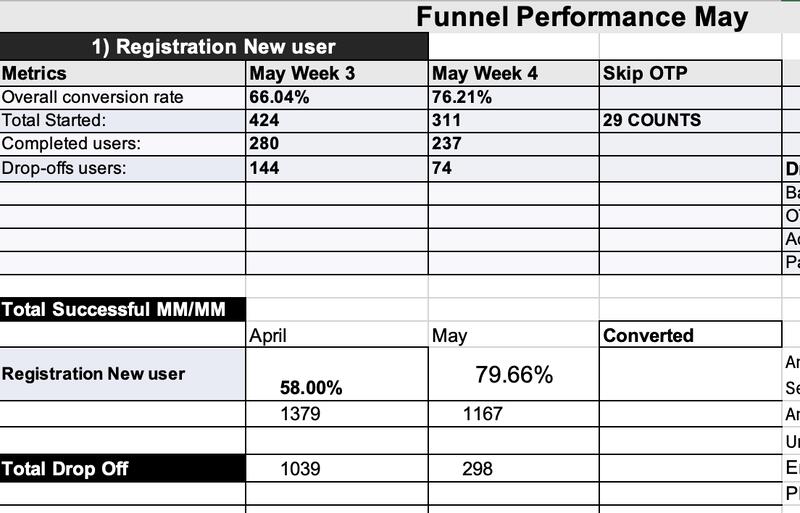
The Data Shows the Improvement. This funnel report from Mixpanel compares May Week 3 (before optimizations), May Week 4 (initial improvements), and shows the impact of the "Skip OTP" feature launch:

Funnel Performance May: Registration conversion improved from 66.04% to 76.21%, drop-offs reduced from 144 to 74 users

What the Data Reveals: In May Week 3, we had 66.04% conversion with 144 drop-off users. By May Week 4, conversion jumped to 76.21% with only 74 drop-offs—a 50% reduction in user abandonment. The "Skip OTP" feature (showing 29 users who bypassed OTP verification) gave users an alternative path forward when OTP delivery issues occurred.

Total Successful MM/MM metrics show the longer-term impact: April registration success was 58.00% across 1,379 new users. By May, we achieved 79.66% across 1,167 new users—showing sustained improvement in conversion quality and reducing monthly support load from 1,039 drop-offs to 298.

The Bottom Line: 76% conversion (and trending toward 80%) proves that addressing both technical reliability and UX friction delivers real, measurable results. Users now flow through registration smoothly, with clear fallback options when issues occur. Support burden dropped 71%. User acquisition improved dramatically.

Key Learnings

1. Technical Issues Masquerade as UX Problems
The OTP delivery failure wasn't fundamentally a design problem—it was a reliability issue. But our UX response (Skip OTP feature) was critical. Good design can't hide bad systems, but it can provide graceful fallbacks while technical issues get fixed.
2. Data-Driven Design Beats Assumption
Mixpanel told us exactly where users were dropping off. Without that data, we might have redesigned the entire registration experience. With it, we focused on the real problems. Always measure before designing.
3. Cross-Functional Collaboration Accelerates Solutions
Fixing OTP delivery required development partnership. Escalating the lead code issue required consistent communication. Building the Skip OTP feature required close collaboration between UX and backend. No team solved this alone.
4. Error Recovery Matters More Than Error Prevention
We couldn't prevent all OTP failures. But we could give users a way forward when OTP failed. The Skip OTP feature showed that designing for error recovery—not just error prevention—creates resilient user experiences.
5. 24 Percentage Points of Improvement Compounds
Going from 52% to 76% conversion is a 46% relative improvement. Over a year, this difference compounds dramatically in terms of user acquisition, retention, and lifetime value. Conversion optimization is leveraged work—small percentage improvements drive massive business impact.