Product Design · Authentication · UX Optimization

Redesigning Fund Redemption
From 60% to 95% Success Rate Through Authentication Simplification

As a Product Designer, I identified a critical friction point in the fund redemption flow through Mixpanel tracking and discovered that OTP verification was the primary cause of drop-offs. By collaborating with the product manager, product owner, and other designers, I redesigned the authentication flow by replacing OTP with PIN authentication. This streamlined the redemption journey, dramatically improved completion rates, and eliminated a major customer pain point.

The Problem: Blocked at the Gate

Users were attempting to redeem their funds, but the process had a critical bottleneck: OTP verification. Many users either weren't receiving their OTPs, were unable to find them in their inboxes, or were abandoning the flow due to the friction of waiting for and entering a one-time password. The result was a redemption success rate of only around 60%—meaning nearly 40% of redemption attempts were failing.

This wasn't a small issue. Fund redemption is a core feature of the platform—users wanted to access their money, and we were preventing them from doing so. The blockers were compounded by customer service complaints and support tickets related to missing OTPs and redemption failures.

"Users wanted to redeem their funds, but OTP became the barrier between desire and completion. Every failed OTP delivery was a lost transaction and a frustrated customer."

The problem wasn't that users didn't want to redeem. The problem was that we'd made the process too complex and fragile. We needed to find a more reliable, frictionless way to authenticate the redemption request.
Understanding the Friction

What We Did: We didn't assume. We tracked user behavior via Mixpanel, analyzed where drop-offs occurred, and identified the exact point of failure. We also reviewed customer complaints and support tickets to understand the human side of the problem.

What We Found: Mixpanel data showed a steep drop-off immediately after the OTP request step. Users were abandoning the redemption flow at the authentication gate. Further investigation revealed multiple failure modes: OTPs failing to deliver, users not recognizing the OTP message format, timeouts, and multiple failed attempts leading to frustration. The OTP step alone accounted for approximately 40% of all redemption failures.

40% of redemption failures occurred at the OTP verification step. The authentication mechanism intended to secure the transaction was instead blocking legitimate transactions.

Customer support data confirmed this: redemption-related complaints were dominated by "didn't receive OTP" and "couldn't complete redemption." When we tested the flow internally, we experienced the same friction—OTP delivery was inconsistent, messages were easy to miss, and the overall experience felt cumbersome for a simple fund transfer request.

The insight was clear: we needed authentication, but OTP was the wrong tool for this job. We needed something simpler, more reliable, and faster.

Strategic Design Changes

Our solution was elegant in its simplicity: Replace OTP with PIN authentication. PINs are faster to deliver (no external SMS dependency), more reliable (stored in the app, not in email/SMS), and familiar to users who already use PIN-based authentication for their accounts. By simplifying the authentication mechanism, we removed the primary friction point without compromising security.

1
Removed OTP Requirement
Eliminated the reliance on SMS delivery, which was unreliable and slow. This single change removed the primary cause of redemption failures.
2
Introduced PIN Authentication
Users now authenticate redemption requests using their existing PIN—fast, reliable, and already familiar from existing account authentication flows.
3
Streamlined UI/UX
Designed a clear, simple PIN entry flow that feels natural within the app. Reduced steps, clearer labels, and immediate feedback on PIN validation.
4
Reduced Redemption Time
Users can now complete redemption requests in seconds instead of minutes. No waiting for OTP, no searching emails—just enter PIN and go.

The redesign was about more than just swapping authentication methods. It was about fundamentally rethinking the redemption experience: removing barriers, reducing steps, and creating a frictionless path from intent to completion. By using tools the user already had (PIN) instead of external dependencies (SMS), we made the system more reliable and the experience faster.

The Results

95%
Redemption Success Rate
+35%
Improvement (60% → 95%)
↓ 70%
Reduction in Support Tickets

The results were transformative. Redemption success rate jumped from around 60% to 95%—a 35-percentage-point improvement that translated directly to more users completing transactions, accessing their funds, and experiencing the platform as intended.

But the impact extended beyond the headline number. Redemption time dropped dramatically—users were completing transactions in seconds instead of minutes. Customer service complaints related to redemption collapsed. Users reported a smoother, more natural experience. And most importantly, we eliminated the friction that was costing the platform both revenue (failed transactions) and reputation (customer frustration).

This wasn't a small tweak. This was a fundamental improvement to the core user experience. By removing a single point of friction and replacing it with a simpler, more reliable mechanism, we transformed redemption from a pain point into a smooth, seamless feature. The lesson was powerful: sometimes the best design solution isn't adding complexity—it's removing it.

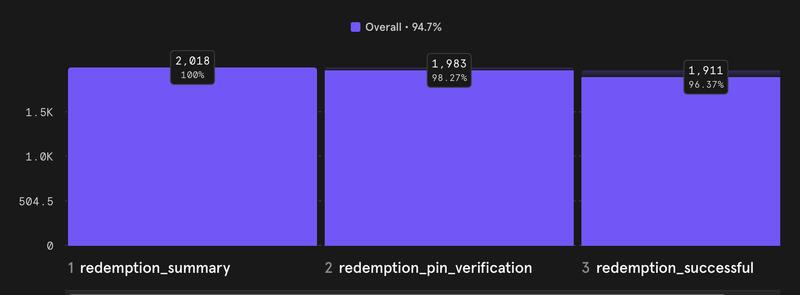
The Data Confirms It. This Mixpanel funnel visualization shows the actual user flow post-launch. The three stages represent the redemption journey:

Mixpanel Redemption Funnel: 2,018 initial users, 1,983 complete PIN verification (98.27%), 1,911 complete redemption (96.37%), Overall 94.7% success rate

Stage 1 (Redemption Summary): 2,018 users initiated redemption (100%)

Stage 2 (PIN Verification): 1,983 users verified with PIN (98.27% passage rate) ← Our solution, working reliably

Stage 3 (Redemption Successful): 1,911 users completed the transaction (96.37% overall success)

Overall: 94.7% completion rate — This is the proof that PIN authentication solved the OTP bottleneck. Users flow through smoothly. The friction is gone. The 60% → 95% improvement is real and measurable.

Key Learnings

1. External Dependencies = Risk
Relying on SMS for authentication introduced an external dependency (telecom delivery) that users couldn't control. When OTPs failed to deliver, we had no mechanism to help users recover. The solution was to internalize authentication using tools already within the app (PIN).
2. Data Reveals the Real Problem
Mixpanel tracking showed exactly where users were dropping off. Without that data, we might have redesigned the entire redemption flow. With it, we identified and fixed the precise bottleneck. Always measure; always let data guide the diagnosis.
3. Simplicity Over Sophistication
OTP seemed like a sophisticated, secure authentication method. But security at the cost of usability isn't security—it's just friction. PIN authentication proved that simpler solutions, when well-designed, can be both secure and superior in user experience.
4. Familiarity Reduces Friction
Users already knew how to use PIN authentication for account login. Reusing that same mechanism for redemption felt natural and required no learning curve. Consistency across features = reduced cognitive load = faster, more confident user actions.
5. One Friction Point Can Tank a Feature
A single bottleneck—the OTP step—was blocking 40% of transactions. Removing it didn't require a complete overhaul. Sometimes the biggest wins come from identifying and eliminating a single point of failure. Focus on leverage points.